
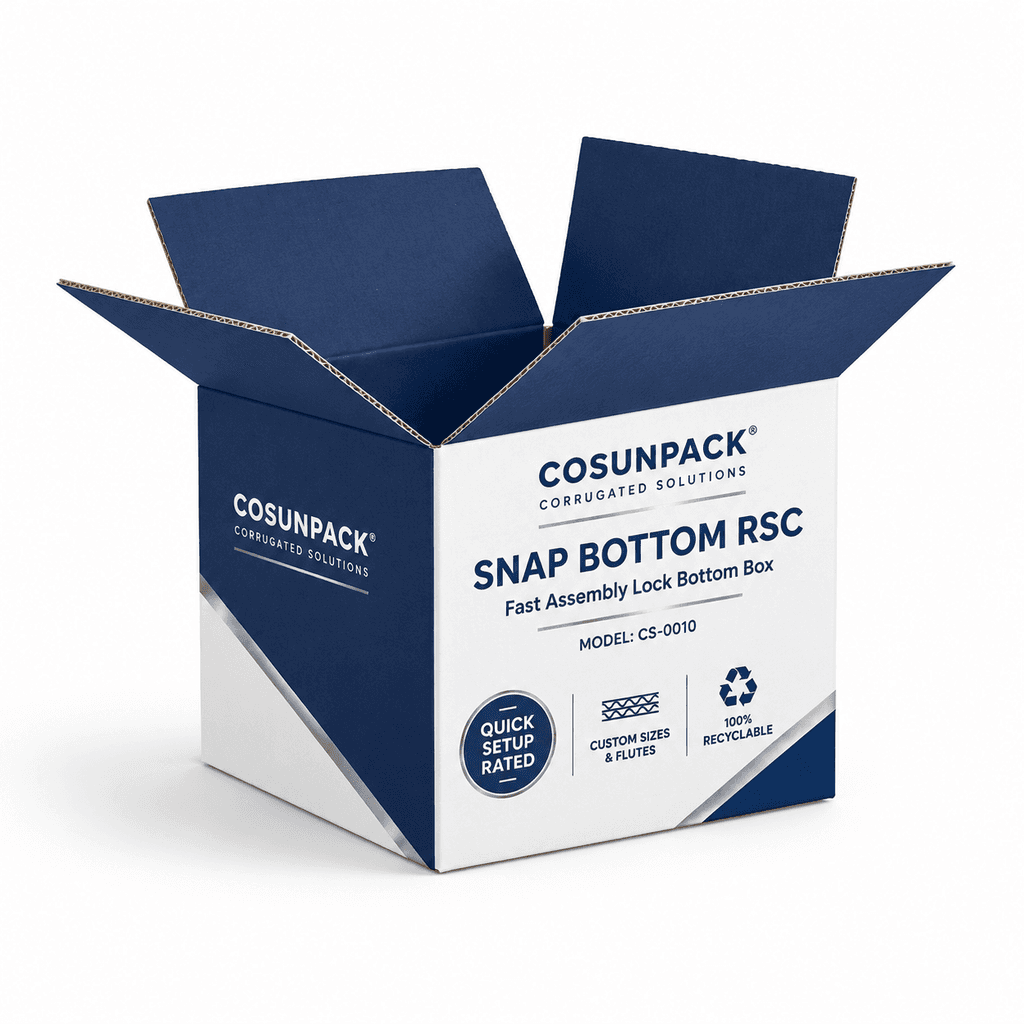
Snap Bottom RSC
Snap Bottom RSC: Corrugated packaging sized around your product, packing method, and shipping conditions. Board grade, print, and assembly details are confirmed in your quotation.
Product Highlights
- Recycling suitability reviewed for the selected board, coatings, and destination
- Consistent compression strength for stacking and transit
- Water-resistant coating for cold-chain and humid routes
- Litho-lamination pairs corrugated strength with HD graphics
- Sized to optimize pallet cube and freight cost
- Engineered flute selection (E/B/C/BC) balances strength and freight cost
- Ships flat, sets up fast—storage and freight friendly
Craftsmanship & Production
Production steps and quality checks for this packaging format, coordinated across our printing workshops and specialized production network.
Customization Options
Review the available options for Snap Bottom RSC with our team. These are the requirements to confirm:
- Flute type (E / B / C / BC)
- Dimensions & board grade
- Flexo / offset-litho / digital print
- Die-cut shapes & vents
- Coating & varnish
Specification Planning — Snap Bottom RSC
Review these material and process options for the selected structure. Your quotation confirms the exact specification for your project.
| Material | Corrugated board, E / B / C / BC flute, kraft or white top |
|---|---|
| Structure | Snap Bottom RSC |
| Size Range | Dimensions or capacity confirmed against your product and selected tooling |
| Thickness | Material thickness or weight confirmed in the approved specification |
| Printing | Flexo (1–4 colors), offset-laminated, or digital |
| Finishing | Water-based or UV varnish, laminated litho label |
| MOQ | Quoted per material, structure, print process, and order quantity |
| Sampling Lead Time | Confirmed after the artwork, structure, and tooling review |
| Production Lead Time | Confirmed after sample approval and production planning |
| Typical Applications | Shipping, e-commerce, subscription, retail-ready packaging |
Options shown for planning; final parameters are agreed in writing with your quotation and approved sample.
Before You Order
Snap Bottom RSC FAQ
Practical answers on choosing the structure, avoiding common problems, and confirming the right specification for your product.
Does the snap bottom need manual assembly?
Confirm the actual bottom drawing: a manually interlocking base and a factory-glued automatic base can be described loosely as snap bottoms. Request an erection demonstration and trial it with your packing staff before comparing assembly steps or selecting equipment.
Technical references
Can the snap-bottom RSC hold a concentrated load?
Do not infer this from the locking action alone. Provide product weight and contact shape, especially narrow feet or dense bottles. Load a sample and assess the bottom engagement and support; an additional base pad or different closure may need comparison.
Technical references
Is a snap bottom sealed against dust or small loose parts?
An interlocking base can leave openings at flap joints. Review the smallest contents and cleanliness requirements, then inspect an erected sample with the intended inner bag or liner. A mechanically engaged bottom should not be described as a continuous barrier.
Technical references
How should we check the RSC top with this bottom?
Trial the entire packing sequence from bottom erection through top sealing. Confirm the base is fully engaged before filling, then check that product height allows the RSC flaps to meet. Record any packer adjustments that could make base assembly inconsistent during a run.
Technical references
Have a different application? Share your requirements for this model.
One Partner for Your Complete Packaging
Source packaging from China with one team, from product-led development to delivery. Share your product or idea, component list, quantity, and destination—we will help define the next steps.